
Sunday, May 19, 2013


Thursday, April 25, 2013
Cambro Announces “Ask Shelly: The Friendly Health Inspector” Campaign
Do you have a food safety question?

Monday, April 22, 2013

Sunday, February 3, 2013
3D Printers are they the Wave of the Future?
Robohand: How cheap 3D printers built a replacement hand for a five-year old boy
 Ivan Owen in Bellingham, Washington and Richard Van As in South Africa—have published the design for Robohand, the mechanical hand prosthesis, on MakerBot's Thingiverse site as a digital file that can be used to produce its parts in a 3D printer.Check out the article above and the video.
What do you think could 3D prints also have Environmental Health impacts in the future?
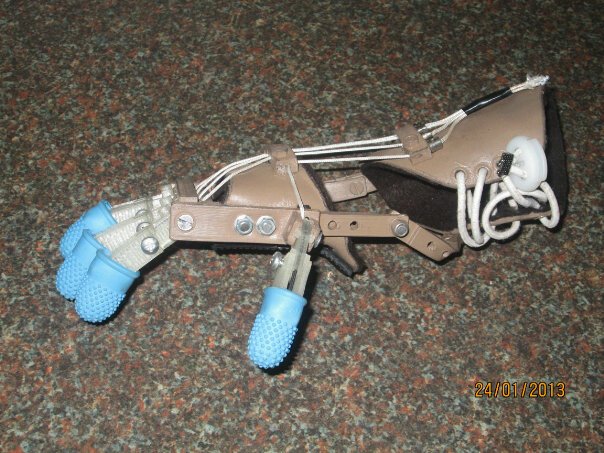 Ivan Owen in Bellingham, Washington and Richard Van As in South Africa—have published the design for Robohand, the mechanical hand prosthesis, on MakerBot's Thingiverse site as a digital file that can be used to produce its parts in a 3D printer.Check out the article above and the video.
What do you think could 3D prints also have Environmental Health impacts in the future?
Sunday, January 20, 2013
 Curious what sessions could be at the NEHA 2013 AEC?
 Detailed session and event information for the National Environmental Health Association's Annual Educational Conference (AEC) & Exhibition will be posted on neha2013aec.org later in January.
In the meantime, NEHA has posted online many of the abstracts that were submitted for consideration. To review these abstracts, see what your peers have to say about them, and/or post your own comments, visit www.neha2013aec.blogspot.com.
Friday, October 19, 2012
Wildfire Destroys our Neighborhood: A Survivor’s Story

See NEHA 2013 Abstracts for more details
Friday, September 21, 2012
Environmental Health, There's an app for that!

The City of Evanston began using iPads with WiFi connections to support Food Inspections and General Environmental Health Programs in the Fall of 2012. Sanitarians perform Food Safety Inspections via iPads and the ACELLA app. Upon completing a Food Establishment inspection a document is created on the screen which can then be sent electronically to the Food Establishment. As soon as the inspection is finished the results are also posted on the city's website, so the operator has a number of opportunities to view the inspection and the public can view the inspection minutes after it happens. Our sanitarians utilize YouTube to provide educational videos during inspections. Sanitarians can view food establishment floor plans for final inspections on the iPadS and have policies, procedures, and technical information at their fingertips through an online service called Dropbox. Dropbox allows documents to be stored on the tablets and updated from the office or in the field as necessary. The City has also worked with GovQA and established a 311 system in 2011 aimed at improving efficiency and transparency of services. Residents can enter requests for service online or via telephone our inspectors receive the requests in their email queue and respond in the field while onsite performing the inspection. Our Sanitarians are now deployed in the field and do not have to stop in the office to update databases or finish paperwork. It can all be done in the field. Implementation of both software systems and the tablet technology of the iPads has allowed the division to greatly reduce the amount of paper we use making us a greener division. Check out more abstracts for NEHA's AEC here.
Tuesday, September 18, 2012
Don't Call Me a Health Inspector!

I have to say, I agree that when I did inspections for over 13 years I hated it when people called me a health inspector. There was so much more to what I did than inspect retail food facilities. In addition, I used a lot of science and critical thinking skills to determine if a process was safe in regards to numerous issues. For example, was the way that a child care facility handling diaper changing putting children at risk for illness. Is the water we drink safe, what about the air we breath, then there is protecting the public from harmful animals and insects that carry human diseases. The list goes on and on.
Therefore, Environmental Health Specialists are trained in numerous areas to help protect the public from their environment to increase their quality of life. So the next time you see someone inspecting a facility or working to make our environment and communities safer. Say thanks and don't call them a "Health Inspector". Have a great day and enjoy the clean air, water, and safe food.
Shelly Wallingford, Registered Environmental Health Specialist (REHS) working hard for you and all our families every day.
Monday, September 17, 2012
“EPA Decentralized MOU Partnership Releases Papers Highlighting the Benefits of Decentralized Wastewater Treatment Systems”
 The U.S. Environmental Protection Agency (EPA) Decentralized Memorandum of Understanding (MOU) Partnership has developed a series of four paper that highlight how decentralized wastewater treatment systems can be sustainable and appropriate options for communities and homeowners. The papers are intended to provide information to the public and to state, local, and industry officials on the benefits and types of decentralized wastewater treatment systems. Decentralized wastewater treatment consists of a variety of onsite approaches for collection, treatment, dispersal, and reuse of wastewater. The MOU Partnership is an agreement between the EPA and 16 partner organizations to work collaboratively at the national level to improve decentralized performance and our nation’s public health and water resources. Since 2005, the MOU has reflected the commitment of EPA and its partner organizations to work together to encourage proper management of decentralized systems and increase collaboration among EPA, state and local governments, and decentralized system practitioners and providers.
In 2011, the MOU Partnership convened working groups to develop papers around each of four topic areas. MOU partners were selected to participate according to their area of expertise. Each paper focuses on one of four topic areas of decentralized wastewater treatment, demonstrating how decentralized wastewater treatment can be: (1) a sensible solution; (2) cost‐effective and economical; (3) green and sustainable; and (4) protective of the environment, public health, and water quality. For additional information on the EPA Decentralized MOU Partnership and to view copies of the papers, please visit: For more information click here!
The Sequel to What's Hiding In Your Sandwich
Go to NEHA abstracts for 2013

Join us as we look at the reasoning behind why the FDA allows some contaminates in our foods. Then you’ll be tested on some examples of natural and un-natural contaminates found in our food! We’ll look at some recent methods of foreign material detection and procedural systems to prevent

Join us as we look at the reasoning behind why the FDA allows some contaminates in our foods. Then you’ll be tested on some examples of natural and un-natural contaminates found in our food! We’ll look at some recent methods of foreign material detection and procedural systems to prevent
Friday, September 14, 2012
Camplo What?

Campylobacter is a foodborne illness that use to be one of the most common followed closely by salmonella. Camplobacter is a bacterium that is mostly associated with consuming under cooked chicken, but there are other ways to contract the illness as well. Fortunately, public health professionals have been working hard to reduce the incidence of foodborne illnesses in general and they have made some significant progress in the last several years. CDC estimates that of the seven major pathogens, they have all gone down except Salmonella and Vibrio. However, are we going to start losing ground with all the tax cuts to public health and environmental health specialist that help to educate and prevent these illnesses?
Does this matter to you? So what, so people get a little diarrhea what is the big deal! I have heard people say this and let me tell you it can be a very big deal. For example, Campylobacter can make you very ill with bloody diarrhea and can have lasting health affects for people who develop a rare disease called Guillain-Barré syndrome that affects the nerves of the body. Some illnesses can cause death like E-coli 0157:H7. Do you want to take a chance that you will be one of the people hospitalized or that die from foodborne illness when it can be prevented?
We all need to understand and work to protect ourselves and the environment from these illnesses and support the individuals that work every day to make the world a better place!
Saturday, September 1, 2012
Why I am an REHS!

As an Environmental Health Specialist for over 13 years I
have always felt that having a credential was important to the
profession. That is why even though Colorado doesn't require a credential
to work in the state I got my REHS. As an REHS, I am showing support for
my profession and providing proof of my proficiency to conduct this important
work. Unfortunately, there is no national standard for credentialing the
field of Environmental Health. Now, more than ever, it is important to
show the value and expertise of our profession since government budgets are
shrinking and the public is losing faith in government employees.
Environmental Health Specialists need to come together and show their
communities the value they possess. Professionals in the field of
environmental health need to work together to develop a credential and a voice
that is strong and that helps people to recognize the great work they do.
When someone says they are a doctor no one wonders what kind of work they
do. That is the kind of understanding and recognition that a national
credential for the field of environmental health can do. As
professionals, we all need to work to make sure everyone knows what great work
we do and that is why I am and REHS. How about you?
Thursday, August 23, 2012
Epidemiology, Sampling and Traceback Working Synergistically
In 2010 and 2011 a large number of states and CDC investigated two Salmonella
Agona outbreaks that were giving a "strong signal" for various produce items,
none of which could be statistically implicated as "the most likely
vehicle". Working with CDC, FDA issued an import bulletin targeting
the suspect foods for sampling, import data was analyzed and tracebacks by
the Texas Rapid Response Team were initiated. The combined efforts resulted
in a synergy that identified the vehicle to be contaminated papaya from
Chiapas, Mexico.


Tell us
topics you'd like to hear about and speakers you'd like to see at the
2013 AEC. Review abstracts and provide input. Help NEHA develop a
training and education experience that continues to advance the
proficiency of the environmental health profession AND helps create
bottom line improvements for your organization! To participate in the Call for Abstracts, visit
Monday, April 9, 2012
Educational session at NEHA's AEC

What Do You Do When You Have a Bomb Factory in Your Neighborhood?
Check out this cool session at NEHA's AEC in San Diego!http://neha2012aec.zerista.com/event/member/44455
Wednesday, October 26, 2011
NEHA's abstracts are posted with over 170 to reveiw!
 Be a voice! Now Open
 Tell us topics you'd like to hear about and speakers you'd like to see at the 2012 AEC. Review abstracts and provide input. Help NEHA develop a training and education experience that continues to advance the proficiency of the environmental health profession AND helps create bottom line improvements for your organization! To participate in the Call for Abstracts, visit neha2012aec.org/abstracts.html.
Sunday, October 2, 2011
Needing a LIKE for the sake ofGlobal Health | The "Germ Guy" Blog: Confessions of a Mercurial Microbiologist
Reposted from:
Needing a LIKE for the sake ofGlobal Health | The "Germ Guy" Blog: Confessions of a Mercurial Microbiologist
Who is Involved?
There are many organizations committed to improving global health through funding. In the U.S., there are the Gates Foundation and USAID. In Canada, Grand Challenges Canada has become a leader in these types of grants. This year, Grand Challenges Canada is putting up money to support “Canadian Rising Stars in Global Health.” This is a unique opportunity for those who are up and coming to the global health stage to acquire funding to bring their ingenious ideas to life.
One of these up and comers is a colleague and friend with whom I’ve worked and continue to develop grants and technology. Her name is Dr. Maria DeRosa, at Carleton University in Ottawa and she is indeed becoming a leader in the scientific world and one who I truly believe can change the landscape of global germ health.
She is without a doubt a Rising Star.
Maria is using nanotechnology to find ways to improve and save lives. She’s already talked about how nanotechnology can help feed the world and she’s won several awards including the prestigious John Charles Polanyi award for chemistry. The way she’s going, I’m sure she’s destined to be in the hunt for the Nobel Prize.
Click on the above link to find out how you can help!
Needing a LIKE for the sake ofGlobal Health | The "Germ Guy" Blog: Confessions of a Mercurial Microbiologist
Who is Involved?
There are many organizations committed to improving global health through funding. In the U.S., there are the Gates Foundation and USAID. In Canada, Grand Challenges Canada has become a leader in these types of grants. This year, Grand Challenges Canada is putting up money to support “Canadian Rising Stars in Global Health.” This is a unique opportunity for those who are up and coming to the global health stage to acquire funding to bring their ingenious ideas to life.
One of these up and comers is a colleague and friend with whom I’ve worked and continue to develop grants and technology. Her name is Dr. Maria DeRosa, at Carleton University in Ottawa and she is indeed becoming a leader in the scientific world and one who I truly believe can change the landscape of global germ health.
She is without a doubt a Rising Star.
Maria is using nanotechnology to find ways to improve and save lives. She’s already talked about how nanotechnology can help feed the world and she’s won several awards including the prestigious John Charles Polanyi award for chemistry. The way she’s going, I’m sure she’s destined to be in the hunt for the Nobel Prize.
For this grant, Maria has developed a model to diagnose tuberculosis infection in remote areas of the world, starting in Senegal in Africa.
To make this project easy to understand, she has made a video to show how her research will be used and how she will improve global health. Perhaps more interestingly, she’s used a rather unique way to help viewers understand how her research works.Click on the above link to find out how you can help!
Friday, September 9, 2011
National Environmental Health Association and Return on Investment (ROI)

In the September issue of the Journal of Environmental Health, NEHA President, Mel Knight takes a look at how conference attendance and networking can be your wisest investment. (You can read the President’s column here.)
 NEHA has committed (even more than in the past) to providing our conference attendees with a training and educational experience that not only advances the proficiency of the profession, it also enables attendees to more than pay for their conference experience through the cost savings or revenue enhancements that they can implement back home on the job. (This is a return on investment or ROI.)
 Learn more about the ROI objectives here- http://www.neha2011aec.org/pdf/Overall_Conference_ROI.pdf.
Monday, August 29, 2011
NEHA 2012 AEC Market Research Survey-We want to hear from you!!!!

Click here for the survey
Saturday, August 27, 2011
What is Foodborne Illness?

- Therefore, YES there are some illness that can happen within a few minutes. However it is not common and is referred to as food poisoning.
- Other food poisonings included botulism and is a very serious illness. Symptoms generally begin 18 to 36 hours after eating contaminated food, but can occur as early as 6 hours or as late as 10 days.
- On the other hand, there are illnesses like Hep A that can take up to 50 days to cause illness.
Friday, August 26, 2011
Environmental and Public Health With Some Government Critique Good or Bad Thrown In!: You Can't Just Pick Up A Clipboard
Environmental and Public Health With Some Government Critique Good or Bad Thrown In!: You Can't Just Pick Up A Clipboard: Believe it or not most states require REHS to have a college degree with specified classes and a minimum amount of credits. Each state is di...
Subscribe to:
Posts (Atom)